0

From issue: #32 Un/Stable

From issue #32: Un/Stable

Deborah Ireland, 2 October 2026

Antinomies is a word Jermaine Francis uses in his work to describe a real or apparent contradiction between two conclusions, both of which appear equally logical or justified. 

The starting point for this work began with two photographs in the archives of the Royal Geographical Society. By rights it should have been impossible to take these photographs, dating from 1860, because of the Slave Trade Act of 1807 [1] passed in the British Parliament on the 25th of March 1807, with full emancipation in 1838 [2]  These photos told a very different story, evidence of a history, complex and contradictory and one where what was apparently forbidden, was still taking place.  Researching the photographs led to even more different histories and paradoxes, stretching throughout the nineteenth century. In comparison to the transatlantic slave trade, less has been written on the trade which took place on the East Coast of Africa, and the routes of passage across the Indian Ocean and the Arabian Sea. This is where these photographs took us and on which Jermaine’s work is based. 

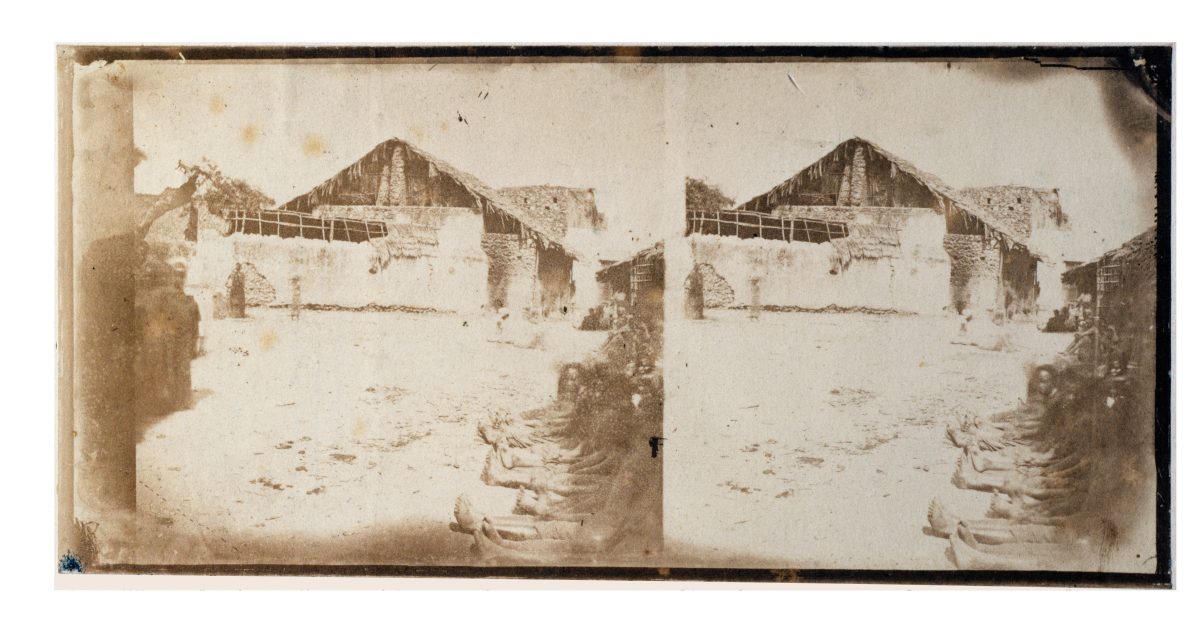
The stereo photograph of the slave market was taken at Stone town, Zanzibar. Sitting on the edge of the Indian Ocean, twenty-two miles east of the African Coast, Zanzibar is an archipelago, the largest island being Unguja. It was presided over by the Iman of Muscat and Oman, with Zanzibar as its administrative centre and a hub for commerce and trade, governed by the Monsoons.

“the custom was for dhows from southern Arabia to make the 2,000-mile voyage to Zanzibar between December and February, when the north-east monsoon blows, returning home again between April and September with the South-west monsoons”. [3]

We know little about the people captured in the photograph, what they feel, or what they are thinking. It would seem that they did not want their photograph taken. The photographer records that those that could, ran away as he set up his camera. The women, who were unable to move, edge the composition with their legs out-stretched leading the eye into an empty market place.  The photographer is perhaps more concerned with recording the place rather than the people as the figures are indistinguishable. But what we do know is that to reach the market they have already made a long and perilous journey. Traveling on foot, joining a caravan of enslaved people moving east towards the departure port of Kilwa, (southern Tanzania). Here they would travel on dhows to Stone Town. This short passage between Kilwa and Zanzibar has been described as a horror worse than the middle passage across the Atlantic as although it was shorter, less care was taken, and if they were becalmed they could perish from starvation or suffocation because of the way they were packed into the dhows [4].

We have no knowledge of the fate of these people. They may have been destined to work in a clove plantation on Zanzibar or Pemba (2,285,712 kilos of clove were exported from Zanzibar in 1856) [5] or they may have been sent north to markets on the Arabian Peninsula.

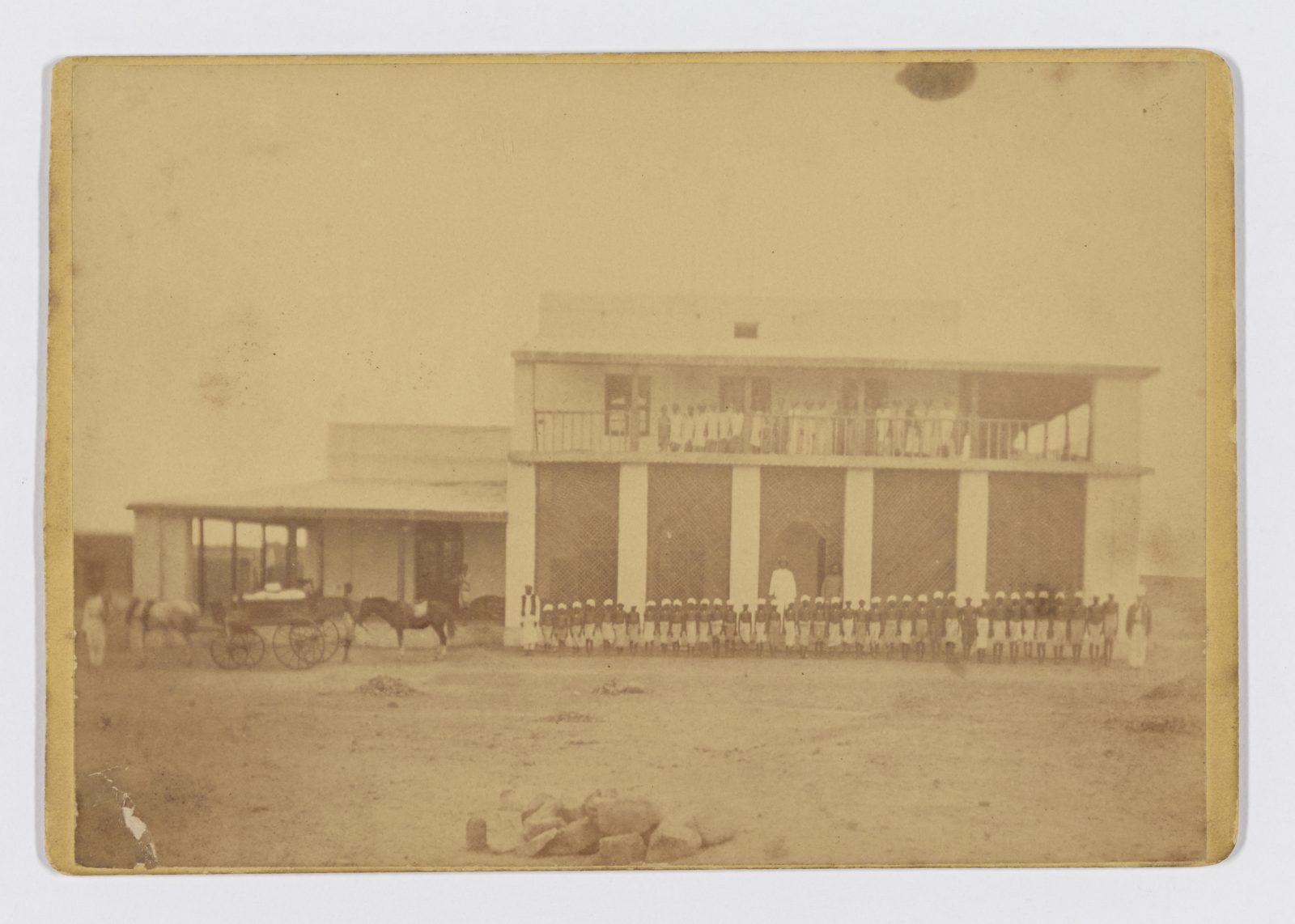
The photograph represents an apparent contradiction, as in the nineteenth century European explorers depended heavily on Omani Arab and Swahili trade networks to travel in East Africa. Explorers presented formal letters and gifts to gain travel documents to ensure safe passage. Letters of introduction were provided by Majid bin Said, the Sultan of Zanzibar. James Augustus Grant (1827-1892), the photographer, is one such explorer. Traveling with John Hanning Speke, he was in Zanzibar to prepare for the 2nd expedition to find the source of the Nile.  Whilst Grant’s own country outlawed the practice, his host economy was based on it:

Slavery and the slave trade remained the base of Oman’s princely fortunes and commercial maritime empire, which was energetically extended during the long reign of Said bin Sultan al Busaidi over the first six decades of the nineteenth century [6].

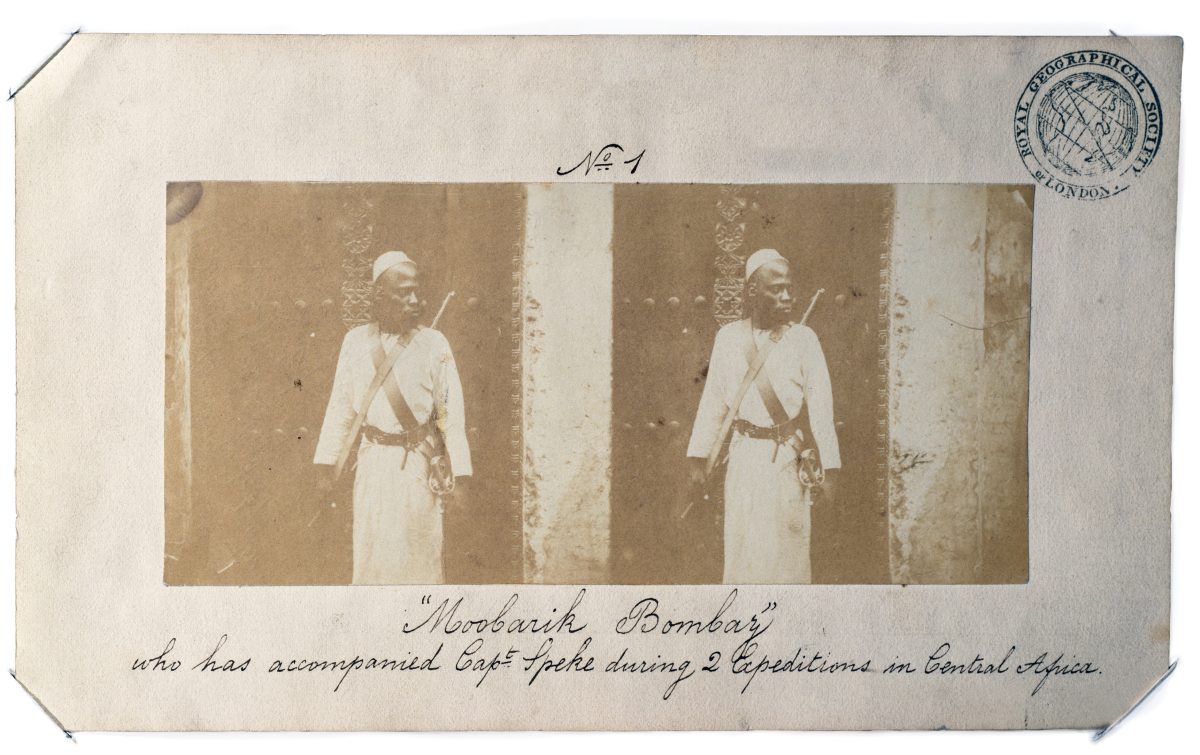
The success of the Nile expedition depended on three men, all of whom had been enslaved and, after their manumission, performed the roles of guides, translators, the managers of porters and leaders of the expedition caravans.  The names we have for them are Mabruki, Baraka and Mbarak Mombée. Mabruki, originally enslaved on Zanzibar, acted as guide for Speke, Burton and later Stanley. Baraka, who gained his freedom serving on a Royal Navy ship, is the commander in chief of this expedition. He was one of many Africans who served in the Royal Navy in the nineteenth century [7]. Mbarak Mombée, referred to by Grant as Moobarik Bombay, was photographed by Grant standing in a doorway, with his gun and sword, the caption reads: No1 “Moobarik Bombay” who has accompanied Capt. Speke during 2 Expeditions in Central Africa. We think he was born in 1820 and was twelve years old when he was taken by Arab traders. He was sold in Zanzibar and then taken to Bombay, where as a servant he was educated in Hindi. His freedom came on the death of his owner and he returned to Zanzibar. Skilled in languages, he was able to converse with Speke in Hindi when they meet in 1856 [8]. The RGS would later acknowledge his role with a pension and a medal, his name runs through the cash books of the RGS pension payments until his death in 1885.

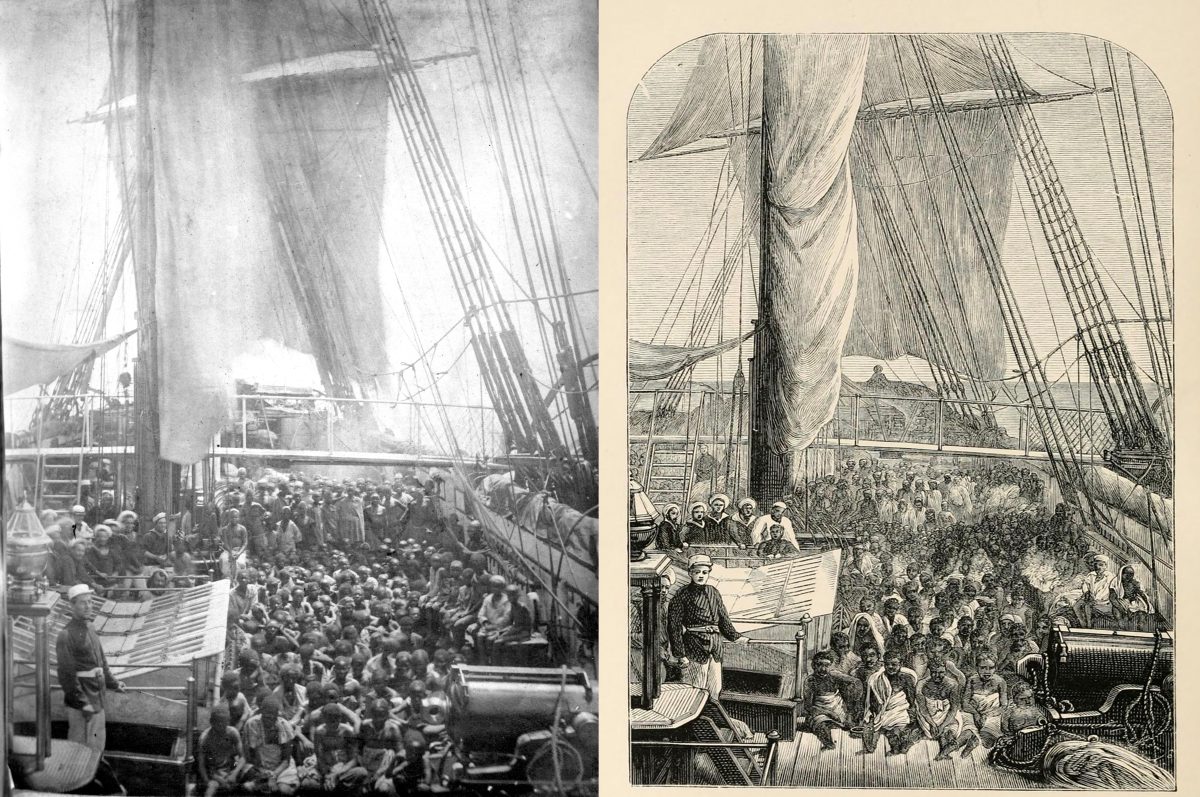
On the shelves of the Royal Geographical Society Library is a book recording one man’s view point of slavery on the east coast of Africa, Dhow Chasing in Zanzibar Waters and on the Eastern Coast of Africa [9]. The author is Captain George Lydiard Sullivan, of the Royal Navy, who had been sent to suppress the trade. The illustrations in the book are engravings taken from his photographs. They are a record of those Africans, “Liberated Africans” who they have taken from Dhows traveling north from Zanzibar in 1869. The engravings are quite crude, the images of children particularly seem quite anglicised and are not an accurate likenesses. Two of Sulivan’s photographs are held in the National Archives and it is possible to make a comparison between the engravings and the original photographs. Sulivan uses his camera to provide proof, to show the large number of people now onboard his ship, H.M.S, Daphne. Three hundred and twenty-two in addition to the crew, speaking eleven different languages and dialects. Testimonies are taken via an interpreter, some of which are reproduced in Sulivan’s book. How accurate they are is hard to say, as questions were asked in Swahili only. In Speaking for themselves? Understanding African Freed Slave Testimonies from the Western Indian Ocean, 1850 – 18302, Edward Alpers and Matthew S. Hopper describe the issues when seeking the voice of the enslaved:

“We draw attention to the numerous problems of translation involved in this kind of basic research and to the critical role played by both indigenous and British interpreters in the process of enabling captive Africans to “speak for themselves”. The lesson here is that the historians must exercise particular care in utilizing these precious sources” [10].

At no point was any effort made to learn the names of the individuals taken from the dhows, the crew gave them English names such as Marlborough, Susan, Ann or Sarah. We know that they were taken to the Seychelles where, because small pox had broken out on the ship, they were quarantined.  When well enough, they were taken to Port Victoria to be registered on the list of “Liberated Africans”. They would then have been indentured or apprenticed for five years, forcibly migrated without choice, “Liberated” yet without agency.

We did find further records of “Liberated Africans” taken to the Seychelles in 1871 by another Royal Navy ship, H.M. S. Columbine.  The Smithsonian Institute published an online exhibition entitled Sailors and Daughters in 2015. In a section entitled Indian Ocean Portraits are faces of “Liberated Africans”, often children who stare back at us and hold our gaze. The photographs are taken from a register: List of Liberated Africans landed from H.M. S. Columbine, 7th of October 1871.  Each entry records a number, sex, name, father’s name, age, height, marks, date of landing, date of registration and how disposed of [11].  The photographs are taken at a point of registration for identification purposes. The information tells us that Emanuel is 11 years old, the son of Sungol, that he has been assigned number 59 and disposed of to V. Morin. We have no further information.

The use of photography to identify indentured migrants and “Liberated Africans” can be traced back to Mauritius in 1864. An Anglo-Indian named Henry Beyts wrote to the Colonial Secretary suggesting that a portrait photograph could be added to migrant tickets to stop fraud and desertion.  After a trial, this was adopted at great expense to the migrant. There was a fear of labour shortages in Mauritius in 1834 and the solution was to bring Indentured labourers to the island.  In Pulled Through Time: Art and the Indian Labour Migrant, Marina Carter explained how between 1834 and 1910, around 455,000 indentured migrants arrived in Mauritius to work in the islands sugar economy, the majority coming from Southern and Northern India [12]. Amongst this number there are 2,635 “Liberated Africans” who were brought to Mauritius and whose photographs were taken and added to their Immigrant ticket. Over 175,000 documents survive, and today they form one of the earliest surveillance photographic records.  Administered by the Mahatma Gandhi Institute, Mauritius, it is an astonishing record.

To conclude with the most recent photograph we found dating from 1889, in the Church of Scotland Mission photography collection, which is held in the National Library of Scotland.

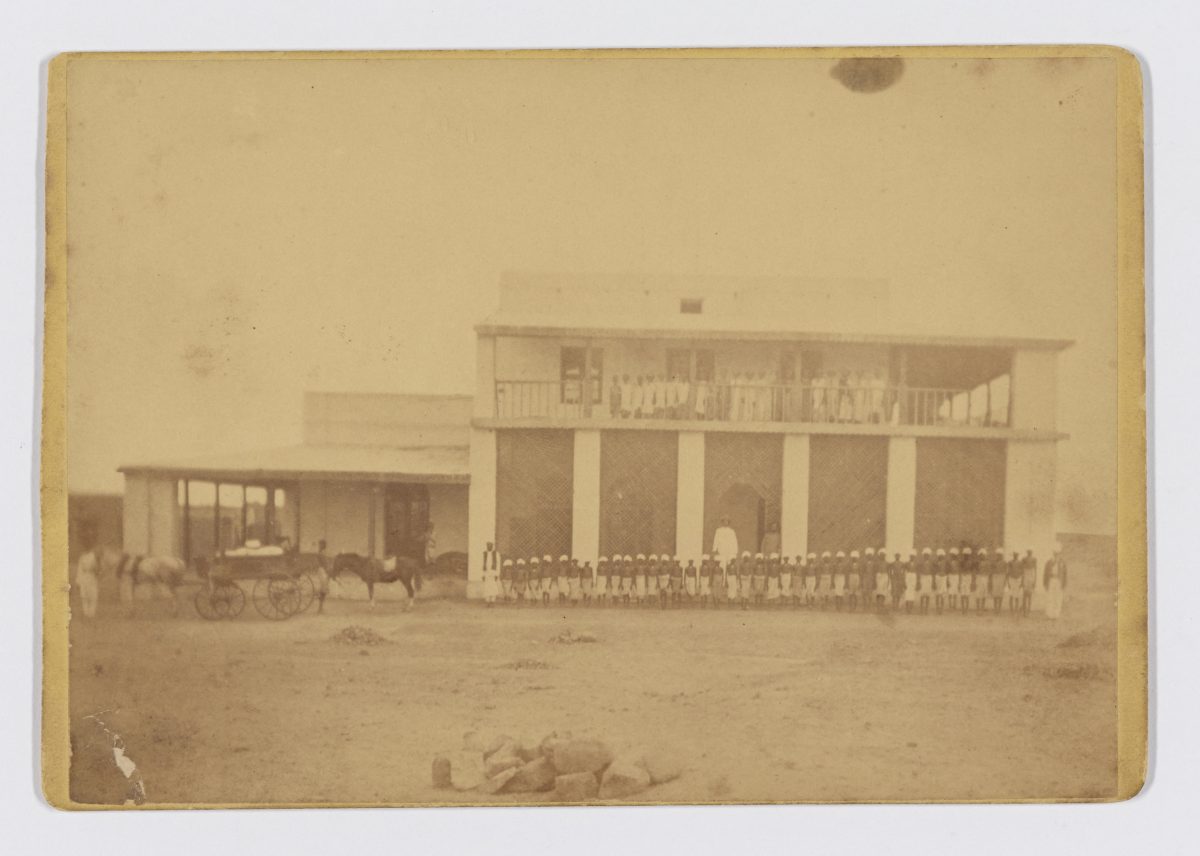
208 children were rescued in the Red Sea by HMS Osprey in 1888. They were taken to the Keith–Falconer Mission, on the outskirts of Aden and were later transferred to the Lovedale Institution in South Africa. The Mission kept the children together as a family, and they were educated.  Great care was taken to record their stories with translators and the Mission staff learned their language.  This information has been published in Children of Hope, The Odyssey of the Oromo Slaves from Ethiopia to South Africa by Dr. Sandra Rowoldt Shell [13], of Rhodes University South Africa. What it revealed is the complex journeys made by each child, frequently being sold and moved. The children were photographed at the Mission.

The photographs are quite faded and indistinct, but they are record of enslavement persisting into the 1880s.

One of the great contradictions is that once “liberated” they can never return to their homeland. Often villages were destroyed, family members killed and, in the case of children, many were too young to remember exactly where they had been taken from.

The nineteenth-century slave trade was to an unprecedented degree a trade in children. Benjamin Lawrence observes that what historians often herald as an age of abolition after 1807 could be more accurately be called the age of the child enslavement [14].

Justin Marozzi in Captives and Companions gives a number approaching 500,000 enslaved exported from East Africa across the Red Sea and the Gulf of Aden in the nineteenth century, with a further 300,000 shipped to the Middle East and India [15].

For further information the Liberated African website is the best starting place to learn more about the enslaved people of Africa who were taken off Slave ships or seized on land. It is an ongoing project and is worldwide and can be found here.

Link to the Smithsonian Institute online exhibition entitled Sailors and Daughters (2015).

We were greatly assisted in our research by the library and collection staff of the Royal Geographical Society, particularly Jamie Owen, Commercial and Partnerships Manager, Eugene Ray, Principle Librarian, Jan Turner, Deputy Librarian and Joy Wheeler, Assistant Librarian. At The National Library of Scotland Alison Metcalfe, Curator of Archives and Manuscript Collection.

Deborah Ireland is a writer, curator, and researcher on the History of Photography with a special interest in Travel Photography. She has worked with both The Royal Geographic Society and Royal Photographic Society with her most recent exhibition, Space Steps at the RPS in 2019, celebrating the 50th anniversary of the Apollo 11 Moon Landing. In 2025 she led a tour to China following in the steps of John Thomson and Isabella Bird. Her publications include: Isabella Bird a photographic Journal of Travels through China 1894 – 1896 in association with The Royal Geographical Society in 2015 and Hasselblad and the Moon Landing in 2018.

[1] Parliament abolishes the slave trade

[2] The West Indian colonies and emancipation

[3] Lloyd, C., 1949. The Navy and the Slave Trade: The Suppression of the African Slave Trade in the Nineteenth Century. London: Longmans. (page 188)

[4] Lloyd, C., 1949. The Navy and the Slave Trade: The Suppression of the African Slave Trade in the Nineteenth Century. London: Longmans. (page 194)

[5] Cooper, Frederick. Plantation Slavery on the East Coast of Africa in the Nineteenth Century. 1977. Yale University. Page 52.

[6] Marozzi, J. (2025) Captives and Companions: A History of Slavery and the Slave Trade in the Islamic World. London: Allen Lane (page 359)

[7] Rankin, J. (2024) Nineteenth-Century Royal Navy Sailors from Africa and the African Diaspora.

[8] Lepere, I. (2024) Mbarak Mombee: An African Explorer Robbed of his name.

[9] Sullivan, G.L. (1873) Dhow Chasing in Zanzibar Waters and on the Eastern Coast of Africa. London: Sampson Low, Marston, Low & Searle

[10] Alphers, A. Edwards and Matthew S. Hopper “Speaking for Themselves? Understanding African Freed Slave Testimonies from the Western Indian Ocean, 1850 – 1930s Journal of Indian Ocean World Studies, 1 (2017) pages 60 – 88.

[11] National Museum of African Art. “Sailors and Daughters: Early Photography and the Indian Ocean World.” Smithsonian Institution, 16 Mar. 2015.

[12] Carter, M., & Flynn, D. (2017). Pulled through Time: Art and the Indian Labour Migrant. South Asian Studies, 33(1), 85–104. 

[13] Rowoldt Shell, S. “Children of Hope: The Odyssey of the Oromo Slaves from Ethiopia to South Africa.” 2018 Ohio University Press.

[14] Anderson, R. (2022). Abolition’s adolescence: Apprenticeship as ‘liberation’ in Sierra Leone, 1808–1848. The English Historical Review, 137(586), 763–793.

[15] Marozzi, J. (2025) Captives and Companions: A History of Slavery and the Slave Trade in the Islamic World. London: Allen Lane (page 362)
Un/Stable
Lands, Anxieties, Dreams

Festival
2026