

From issue: #32 Un/Stable
Echo Callaghan, 2 October 2026
Every second of our lives is mediated by the body. It is the interlocutor of our lived experience, we are bound by its capabilities and limitations. Peter Brooks describes it vividly in the opening to the book Body Work:
“Our bodies are with us, though we have always had trouble saying exactly how. We are, in various conceptions or metaphors, in our body, or having a body, or at one with our body, or alienated from it. The body is both ourselves and other, and as such the object of emotions from love to disgust” [1].
Its a prosaic sentiment that might well ring true for many of us, describing the tension we may feel towards the part of us that mediates both our understanding of the world around us and, unsettlingly, the world’s understanding of us.
This tension, arising from the body’s inherent inseparability from us, coupled with instability of our relationship to it, has long been the centre of much artistic thought. But, regardless of the ubiquity of its representation, artists continue to be compelled by its ability to act as a touchstone for the challenges in expressing the conditions of life.
Part of its continued appeal is that we cannot separate ourselves from the subject matter. Examining the body requires a level of empathetic attention to others, it cannot be achieved purely academically or from a high degree of emotional distance. Instead, when we think about the body we are compelled to think about our own, creating a line of compassionate reasoning that stretches out from ourselves.
Within the works of two artists, Sam Kaufman and Deb Choudhuri, we encounter this empathetic attention to the body being constructed in complimentary ways. At the core of these works lies an urge to express the shifting instability of the embodied experience and to translate alternative constructions of the body to a willing audience. Both artist’s attention rests on the body, but their work explores its unsettled contours and boundaries, examining the ways in which the body reflects its surrounding landscape and portraying the body as one part of a wider interconnected system.
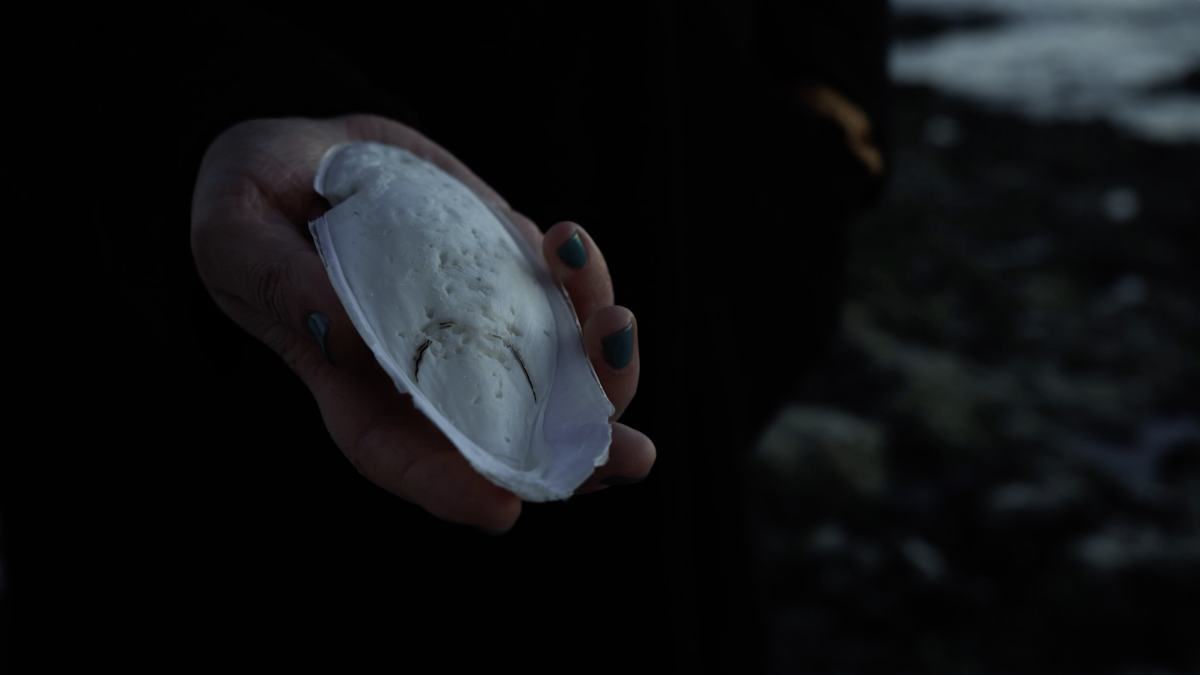
In Kaufman’s moving image work Pseudomorph he centres a cephalopod in all its rippling, flashing brilliance, alienating the audience with its reflection of the complete other – the unknowable body of the animal. This is combined with compelling flashes of landscape, a rocky cliff, the rockpools at the seashore, an underwater scene, even the layered impression of a cuttlefish bone. There is an uncanny similarity between the cephalopod bodies and their natural environment. The curved patterns of the rocks reflected in the geometry of their skin and the movement of the water are echoed in the undulations in pattern that zip across its body as it rests in the gently moving water.
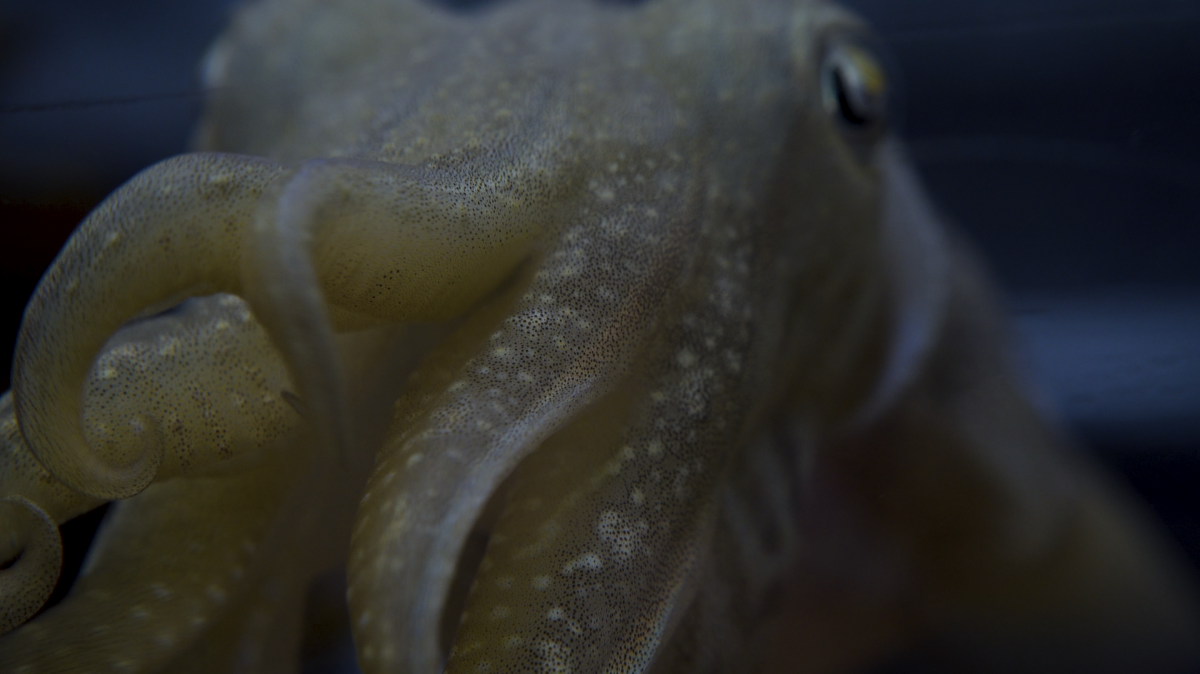
Within the film, Kaufman explores how the cephalopods such as cuttlefish, squid and octopus, have evolved to eject an ink that takes on a glimmer of their own shape, confusing a wannabe predator by redirecting their attention to the ink-impression left hanging in the water. Simultaneously, the voice-over to the work explores the idea of astral projection, instructing the audience on how to manoeuvre their consciousness beyond their current physical confines and out into the ether. In this way, the film depicts the cephalopod’s complex interrelation to the world around it as both eerie and somehow enviable, constructing its shifting state and ability to project ink as a kind of transcendent experience. Interrelation to landscape and evolutionary ingenuity become the catalysts for a type of escapism that is natural to the cephalopod but a distant wish for a human, requiring instruction and practise.
How does the cephalopod relate towards its inky double? How does it feel to project your body out into the world? The work poses these questions with a blend of spiritual curiosity and scientific rigour, connecting the mysticism of out-of-body experiences to the reality of a living creature. However, moments of scientific enquiry feel uncomfortable. The bleakness of the plastic laboratory buckets the cephalopods reside in, the sci-fi qualities of the metal claw that churns dust across the sea-floor and the camera’s lingering gaze on the cuttlefish wellbeing chart. All these moments conspire to create a contrast with the camera’s searching and yet noninterventionist gaze. While scientists are interacting with the cephalopods, the approach of the camera is to gaze and observe, and layering context over the images through the voiceover, the approach becomes philosophical and feels more open and explorative, less damaging to those around it. Philosophy, mysticism and spirituality are brought together to centre an alternate kind of relationship to the body of others, and this combination of approaches creates an opportunity for the audience to explore their openness to alternative ways of understanding the world, challenging their potential scepticism.
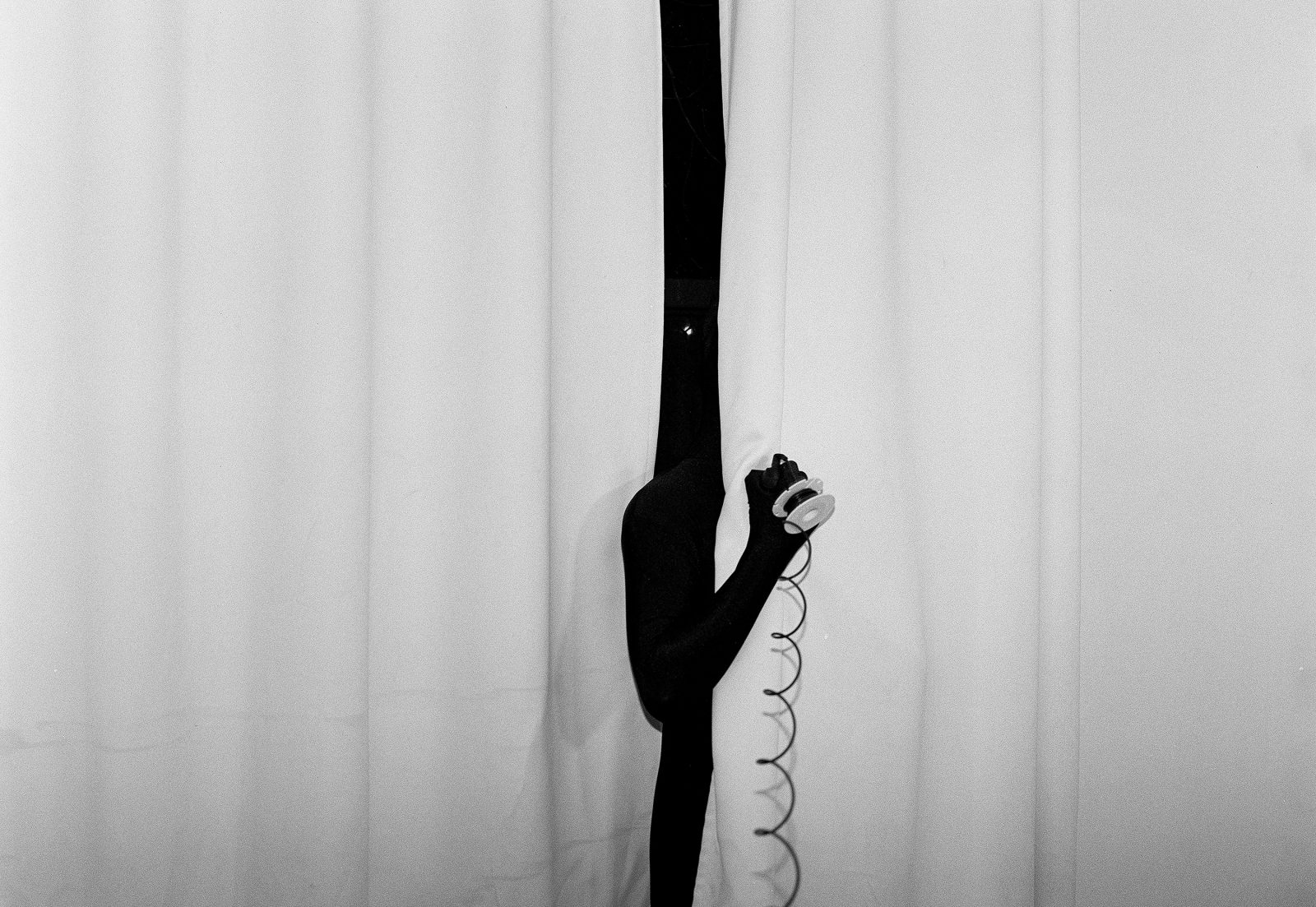
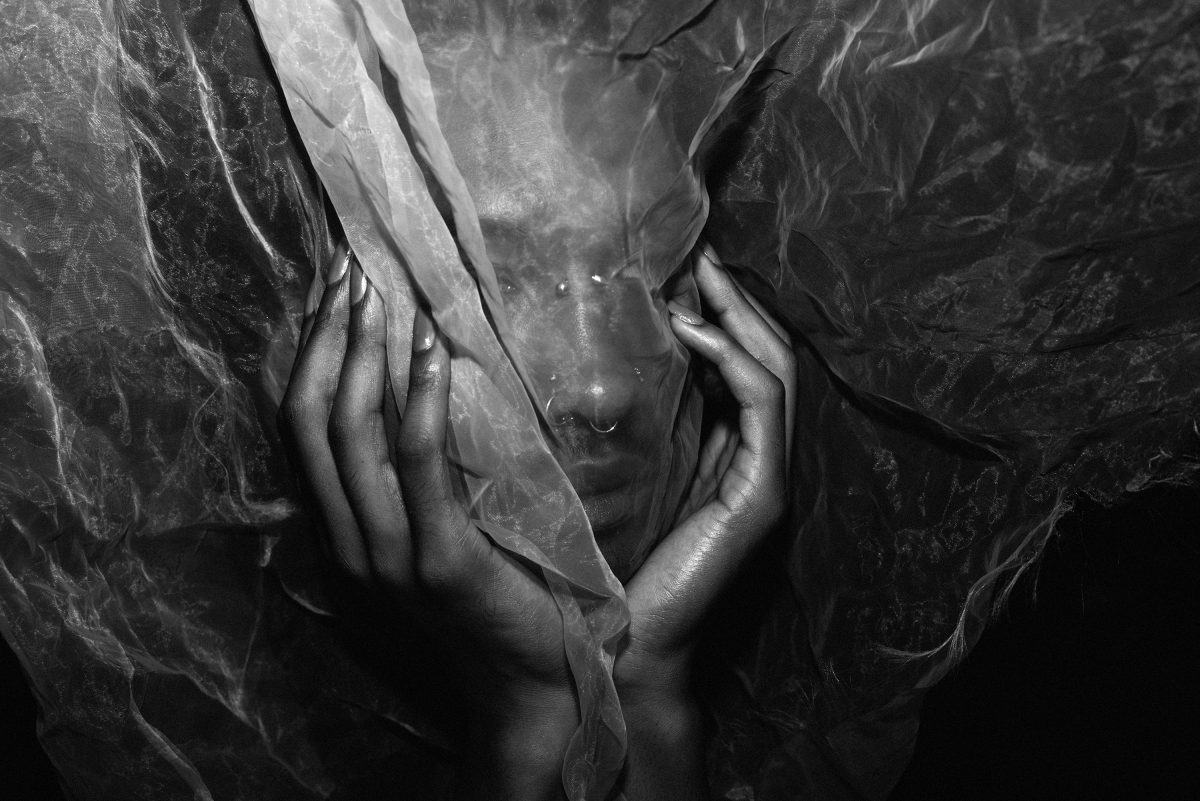
In Choudhuri’s photographic series The Weight of the Earth, physical closeness to the land is correlated with an emotional closeness that suffuses the images with a feeling of nostalgic longing. Whether through the left-over imprint of sand across a back or the blurring of clothing to match its background, these images portray moments where the boundaries between body and landscape slip and reveal a level of familiarity between image and environment.
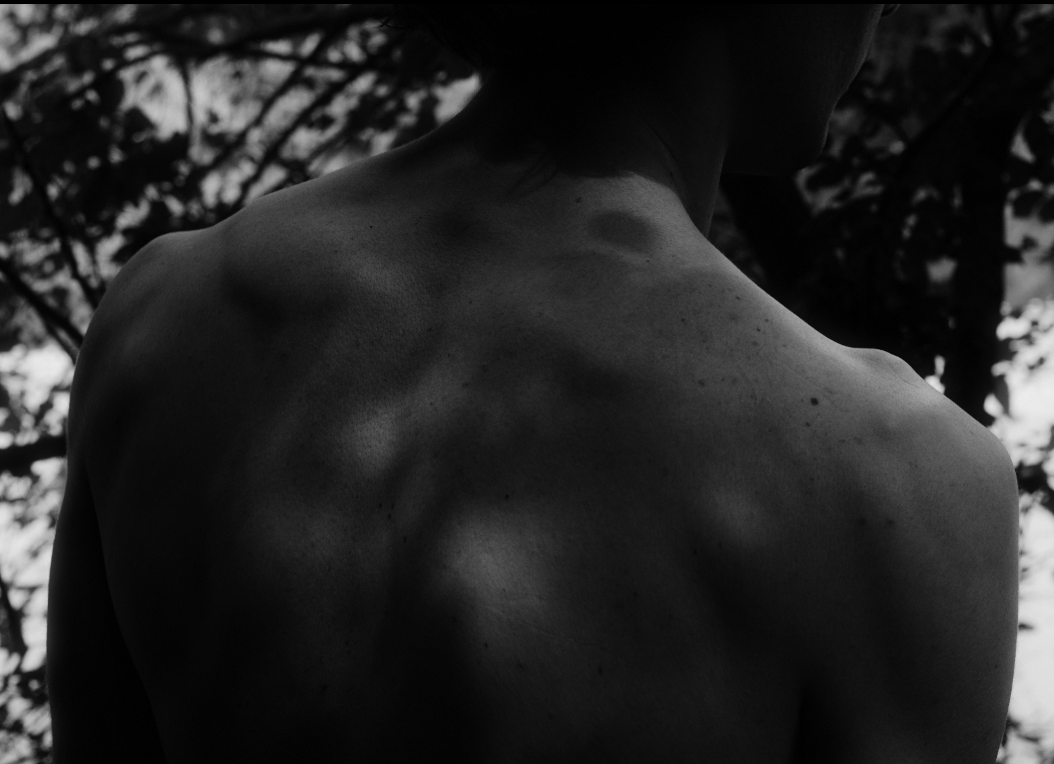
In one image light dappled through the leaves of a tree falls across a naked back, the ridges of the human form taking on the qualities of its surrounding environment. In another, a wrinkled cloth draped over a body catches the light and transforms the body into a landscape or perhaps a sky strewn with constellations of its own, imbuing the character in the image with a more-than-human connection to the natural world. And in yet another, the loose limbs of a figure hang in the air, relaxed and floppy they echo the curved trajectory of the long grasses that populate their surroundings.
Even in an image of an empty landscape, the shadows conspire to create recognisable forms. Is there a face? A body in motion? The viewer is also conscious of the photographer’s body as they stand, looking out into a barren landscape to take the image. Are they part of the scene or merely facilitating it? After a while, the landscape takes on the quality of a dreamscape, the sparkling sand stretching away from the lens. This sand reappears in another image, sprinkled across the back of a prone form, curled up in sleep. Perhaps the photographer was not alone in that vast, open landscape.
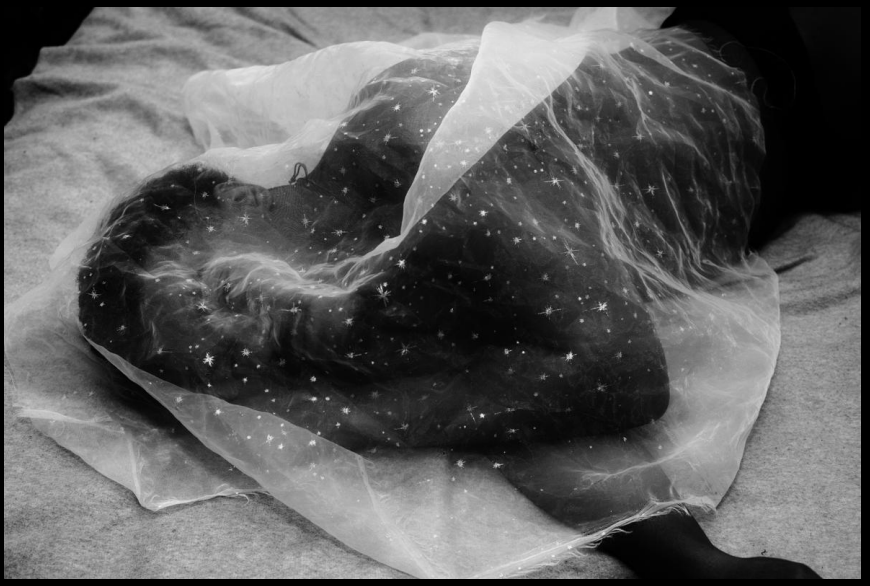
Here, intimacy is contingent on its environment and expressed through proximity to landscape. In Choudhuri’s work it is as if, when the body is relaxed enough, it can form part of its wider landscape, with its peaks and ridges becoming its own kind of topography. Like Kaufman, these works carry with them a degree of idealism and a sense of spiritual connection. These images depict moments where boundaries seem fluid and the body’s inter connectedness to its surroundings feels enviably powerful. However, they also seem somehow fleeting as if these snatches of deep connection with landscape emerge for just a moment before disappearing from the artist’s reach.
Both artists wrestle with the same concept – the relationship of the body to landscape and the viability of a more interconnected kind of embodiment. For both artists the body keeps secrets, it is the holder of intimacies and knowledge, and its strangeness calls us towards ideas of transcendence, with mythical and spiritual undertones. Reaching for an understanding of the body’s relationship to the environment, both engage in a constant return to pattern. The dappling of light, the spray of sand particles, the geometric skin of a cephalopod and the sharp form of rocks on the seashore. In both works the lens of the camera seeks out these patterns and highlights them, bringing forth the correlations between different natural and embodied forms. In the work of these two artists, it is as if the world is engaged in a sacred repetition that their attention has brought forth. The body is inescapable but filled with promise and potential, a vector for closeness and a touchstone for our relationship to landscape, the strangeness of the body creates the opportunity to view it through a lens of tenderness and wonder.
[1] Brooks, Peter. 1993. Body Work: Objects of Desire in Modern Narrative. (Harvard University Press).
Echo Callaghan is an interdisciplinary writer, researcher and interpretation specialist. She has contributed exhibition research, text writing, narrative support and interpretive content to a wide range of art and cultural exhibitions for high profile museums and cultural institutions in the UK and internationally,. She is an experienced art writer, regularly contributing to the magazine A Museum for Now. Her work on the artist Donald Rodney was shortlisted for publication by the International Award for Art Criticism and she is currently one of the Writers in Residence at Photoworks.